

Lucky
I need to tell you something

Good morning friends. Today I am going off script a bit because I’ve been keeping something from you and I finally feel like I’m ready to talk about it. It’s been an eventful spring here in Dinner: A Love Story Land, trips to Ireland and Italy, book parties and author conversations and work conferences, New York restaurant adventuring, and so much good home cooking if I do say so myself — so you’d be forgiven if this next part sounds like it’s coming out of nowhere.
Two weeks ago, we hailed a cab at 5:00 in the morning and drove across Central Park to Lenox Hill Hospital where I had brain surgery to remove an acoustic neuroma from my right vestibular nerve. It’s been an unsettling few months, my recovery will be somewhat unpredictable, it’s too early to have any kind of real perspective on what happened and is happening, but I’m going to be ok. It’s a weird feeling to be experiencing the most physically challenging thing of my life while also being aware of how lucky I am that this is what I’ve been handed. “If you’re going to have a brain tumor, this is the one to get,” my doctor told me on April 20, at 11:15am, pointing at a smudgy mass on the MRI as my whole body floated up to the ceiling. But even in that terrifying moment the gratitude was acute. And every day since, I have only felt more lucky, more loved.
I started noticing strange things last fall. At some point, going for a run became more than just a way to stay in shape, more than a way to ensure good sleep and energy, more than a way to get outside to feel invigorated in the winter, or flushed, leave-it-all-on-the-field in the summer. It became a metric for something mysterious that was going on with my body that scared me and that I was afraid to face.
I’d lace up my Hokas, head to Riverside Park for my standard three-miler along the Hudson, and as soon as I pressed START on my Strava tracker, I’d start to wobble from side to side, get lightheaded and dizzy. Just power through the first seven minutes, I’d tell myself the way I always have. Those are always the hardest. And I would. I’d finish the run, unclear if I felt better by the end or just used to the unsteadiness. In the immediate aftermath of a run I’d convince myself everything was fine. I was running much more slowly, yes, but I’m older, and this is completely normal. At home, I’d google “Is dizziness a symptom of menopause?” And of course it is, because what isn’t? The little AI star would turn and tell me what I needed to hear when I needed to hear it: “30% of all peri-menopausal women experience light-headedness.”
Then, over the next few months, if I really let myself pay attention to what was going on, I realized this unsteadiness was creeping into other parts of my day. As recently as two years ago, I’d sprint down the left side of the stairs from the second level of Fairway, eggs tucked under one arm, a six-pack of IPAs under the other and sail to the first-floor registers for check-out. But at some point, those stairs started to trigger physical fear — I was unsteady, I thought I might fall. I became aware of how much I was carrying, and held the railing all the way down, if not completely skipping the stairs for the elevator. I felt like I was living on a boat. In my living room, I’d stand up after watching TV and pinball between the coffee table and sofa. While walking the dog with my friend Jeni or heading to the coffee shop with Andy on busy West 72nd Street, I’d sway towards them before righting myself and checking to see if they noticed. At the end of March, I drove north on a fast-moving West Side Highway to meet my friend Jodi and had to pull off an early exit because I thought I was going to pass out.
If there was a moment when I decided to finally address what was going on, that was it — I was a danger to other people, not just myself — and yet still it felt too bright to look at directly. I just sort of gently placed the topic on the table by emailing my doctor on the same day I told my niece, Alison, a first-year medical student that I was feeling just a little off kilter and that menopause sucks and isn’t it so crazy how many things estrogen affects and my friend Jennie almost just fell off a treadmill because of it, can you believe that, and I was waiting for a call from my gynecologist to talk about HRTs because what won’t they fix, and isn’t it weird how many people have vertigo and balance and general vestibular issues, specifically women in their 50s? Alison, ever the women’s-health advocate, texted her fellow students sharing outrage over how under-researched these things are! Then she proceeded to give me a full cranial nerve exam in my sister’s kitchen (her test on it had just been that day) and, adorably, administer a newly-learned Epley maneuver on me in her childhood bedroom.
Of course, when I heard back from my gynecologist, the one who delivered both of my daughters and has been practicing medicine for forty years, she wasn’t so convinced by my self-diagnosis. She couched it in niceties (“wouldn’t rule it out” “probably labyrinthitis”) but she was direct: See an ENT, rule out inner ear. Rule out something neurological. It would be nineteen days from that point until my official diagnosis, and I hate how dramatic I sound here, but those were nineteen days that felt like they belonged to someone else. Nineteen days of writing this newsletter about a character named Jenny who lived in New York and just discovered this neat recipe for pressing tofu. Nineteen days of negotiating with the universe. Of OCD on overdrive — If I see a book in the bookstore window that I’ve read before, everything is going to be ok. If I find my favorite olive oil on the same shelf in Trader Joe’s, everything is going to be ok. If I don’t pick up that errant can next to the recycling bin, things will not be ok.
Should we roll it back? I’m going to be ok. Better than ok. Not that I needed the reminder, but my friends, my family, my daughters, my sister, my brother, my mother, my brothers- and sisters-in-laws, my college friends, my friends of friends and sisters of friends, and friends of sisters, and uncles of friends and cousins of friends, new and old colleagues…everyone in my community has been stunning in their generosity and support. Not to mention I feel as though I need to discover an entirely new language, like one that doesn’t involve words, but maybe sparrow songs and celestial dust, to remotely capture how I feel about my husband right now. The love coming at me is intense and technicolor — unless this is the steroids talking — and you can very much expect an upcoming newsletter with the title “Eight thousand ways you can make someone sick feel really fucking good.”
Here, in fact I’m tempted to close out this story with a list of everything I feel lucky for right now, today, July 10, 2026. But I’m going to pace myself and focus on one thing: I can still write this newsletter as I recover. As long as I am mindful about how my day unfolds (where are my “Spoon Theory” people at?) I can sit at my laptop and I can write. I can cook (ish!). I have an appetite. I can read. I have a next-level appreciation for how much pleasure and comfort comes from being fed and preparing food and simply eating delicious things. I can’t wait to tell you about the herby chicken burger that Andy grilled for me last Friday night that nearly brought me to tears; about the novels that have been keeping me company during “Analog Hour;” about my Everything Bagel Chip Epiphany; about a new meditation technique I invented called “The Avenue” that I plan to patent and sell for a million dollars; about how I wake up every day and say to myself I can’t believe I timed my recovery with the World Cup AND apricot season. There is so much more to say…
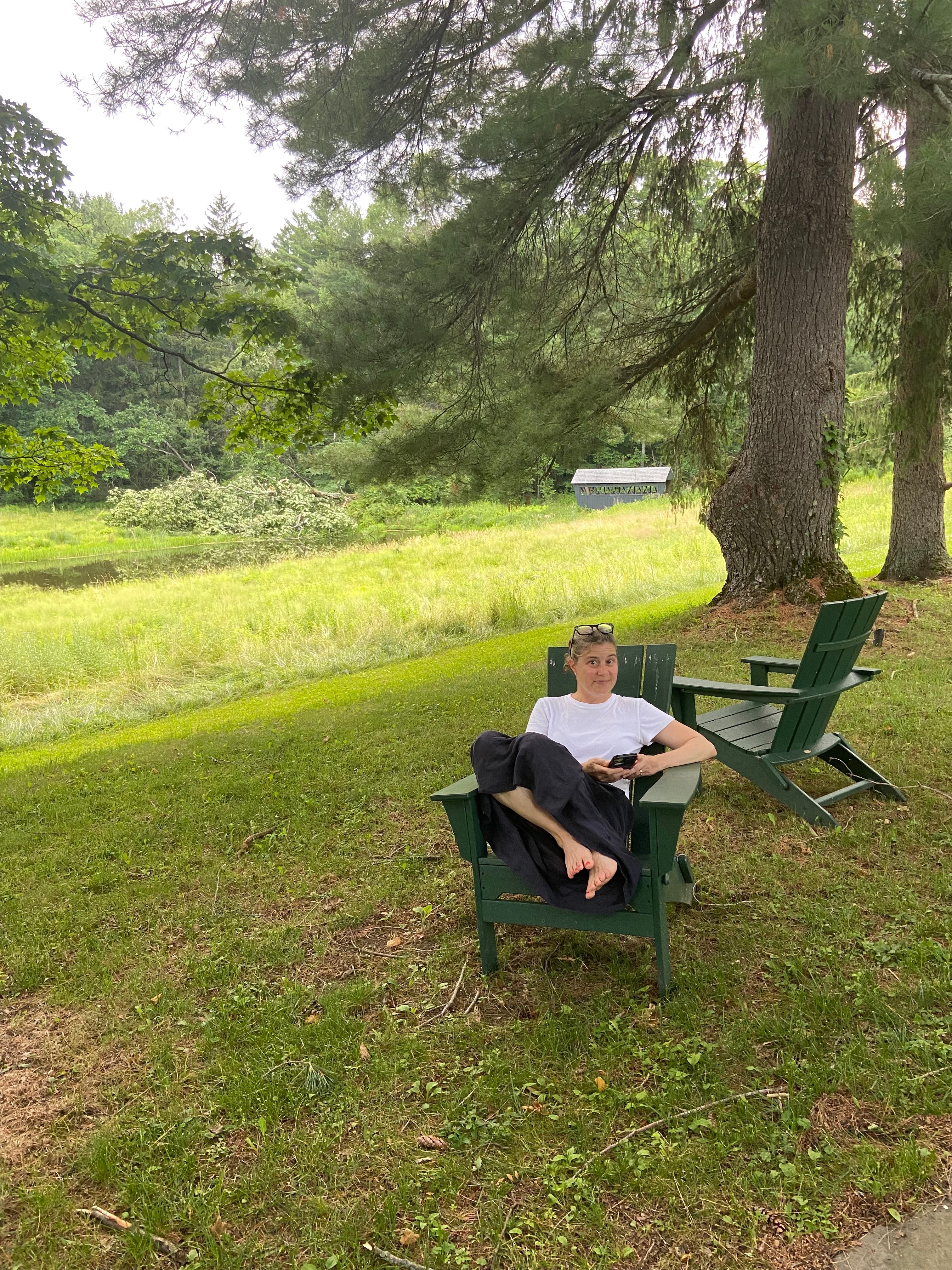
…and, as always, I’m so glad I have this space to say it.
See you next week, thanks for reading.
Jenny
Note: Ever since launching Dinner: A Love Story in 2010, I’ve had to navigate the strange, internet-y question of how much of my private life I want to share — and it might surprise you to hear that the answer is usually: not a lot. I’ve become perhaps too adept at sharing a lot without sharing everything, and though I’ve never once felt like I’ve “owed” anyone any part of my life, this one feels different. To continue writing this newsletter right now, pretending that everything was fine, would’ve been to write a kind of fiction. And perhaps most important, I don’t want to miss any opportunity to connect with readers who are struggling, and who might feel the tiniest bit less alone confronting their own challenges. If that is you, please know I am with you.

Are you an esteemed member of the Acoustic Neuroma community? Please feel free to DM me on Chat or get in touch at jenny@dinneralovestory.com.
Jenny - I feel like after reading your blog and now your Substack for so long, that you’re like a friend of mine (which I’m sure so many others feel as well ❤️). #1 - I’m SO happy you are ok and yes - World Cup recovery is a gift. But thank you for your vulnerability in sharing the hard, the scary, the unknown. It stopped me my tracks reading it but good juju for what’s ahead.
This is such a beautiful piece. Sending love always ❤️